The crossroads at Horwich End, Whaley Bridge. The original black and white postcard is undated but the scene appears to be from the 1950s.
A postman has dismounted from his bicycle outside the White Horse, which until 1963 was a Clarke's Brewery house. Clarke's was aquired by Boddington's and the Reddish brewery closed.
A Post Office Van is parked outside of Horwich End Post Office. A strange looking three wheeled car is turning into Chapel Road.
Monday, 26 August 2019
Christ Church Whaley Bridge
This photograph shows Christ Church on Bings Road, Whaley Bridge in 1910. Study the picture closely and zoom in to reveal some of the details.
Just to the left of the church is a train in the colours of the London and North Western Railway. The railway can be seen to the right of the church where it crosses Bridge 42 over Buxton Road. Alongside is a signal. A wisp of smoke drifts from the tall chimney of the Waterloo Colliery? It stands just in front of buildings on Old Road and Buxton Road; we can see the roof of the chapel, now the Uniting Church. To the left of the train is a crenallated tower. This was the "Upcast Shaft" of Waterloo Colliery and was partof the ventilating system. Above Christ Church roof is a gantry crane; this stood over one of the colliery shafts.
The reservoir is in the background behind the dam wall. Houses can be seen on Reservoir Road including Whaley Hall.
The photograph has been coloured digitally.
Just to the left of the church is a train in the colours of the London and North Western Railway. The railway can be seen to the right of the church where it crosses Bridge 42 over Buxton Road. Alongside is a signal. A wisp of smoke drifts from the tall chimney of the Waterloo Colliery? It stands just in front of buildings on Old Road and Buxton Road; we can see the roof of the chapel, now the Uniting Church. To the left of the train is a crenallated tower. This was the "Upcast Shaft" of Waterloo Colliery and was partof the ventilating system. Above Christ Church roof is a gantry crane; this stood over one of the colliery shafts.
The reservoir is in the background behind the dam wall. Houses can be seen on Reservoir Road including Whaley Hall.
The photograph has been coloured digitally.
Saturday, 24 August 2019
Macclesfield Road
An early photograph of Macclesfield Road, Horwich End, Whaley Bridge. In the foreground are the parapets of the bridge over the River Goyt. Although this scene has changed little, the shops have closed and are now houses. Trees have grown up on the left and (out of view) Clover Chemicals has been built. We have digitally colourised this image from an original black and white photograph
Thursday, 22 August 2019
Whaley Bridge - An aerial view.
This photograph which has been digitally colourised looks down on the centre of Whaley Bridge. The Jodrell Arms Hotel can be clearly seen as can the railway station just behind. Jodrell Road has been built but the fields behind are still to be developed. The flat roofed houses have since had pitched roofs installed. The sign for the Railway Hotel can be seen above the rooftops on the left.
The photograph is undated but was probably taken at some time inthe 1930s.
Wednesday, 21 August 2019
The Whaley Bridge Tea Rooms
This is a view of the Whaley Bridge Tea Rooms or Derbys Tea Rooms as it was sometimes known. It is on Buxton Road opposite the Cock Inn and I understand that the building still exists at the rear of the School Garage.
The building was originally the Whaley Bridge Mission, also known as The Iron Church. The nearby Holy Trinity Church opened in 1905 making the Mission redundant. It thereafter became the Tea Rooms. It apparently also served as the Fire Station prior to the building of the School Garage.
Tuesday, 20 August 2019
Bridge Street, Whaley Bridge
The tracks of the Cromford and High Peak Railway cross Bridge Street. The railway is at the foot of its descent down the cable hauled incline. It crossed the bridge ahead and served both the canal transhipment warehouse and the Bingswood Mill of the Calico Printers Association. The line leading through the gate on the right led to Goyt Mill. The shop is these days, George House antiques, a long established and well known business.
Fish and Chips
Dranfield's Fish and Chip shop on Canal Street,Whaley Bridge is decorated for the celebration of King George and Queen Mary's Silver Jubilee in 1935. In the 1950's this was the business of Harry and Vera McMillen, followed by Ken and Irene Wild.The shop, at No.5 Canal Street still serves fish and chips and is now called "The Fryery". Unusually, the buildings here are numbered consecutively with both odd and even numbering.
Sunday, 18 August 2019
Number 27 at the Jodrell Arms
A bus on route 27 for Buxton, waits opposite the Jodrell Arms in Whaley Bridge in the late 1930s. The bus, a Bristol JO5G model was built in 1936 for the North Western Road Car Company.
Bus services between Stockport and Buxton commenced in 1921 introduced by the British Bus Company of Macclesfield. That company became North Western in 1923 and on 1st March 1928 the new "express" service 27 between Buxton and Manchester began. Buses left Buxton between 7am and 9pm running every hour in the morning and every 30 minutes in the afternoon.
The photograph has been digitally colourised.
Bus services between Stockport and Buxton commenced in 1921 introduced by the British Bus Company of Macclesfield. That company became North Western in 1923 and on 1st March 1928 the new "express" service 27 between Buxton and Manchester began. Buses left Buxton between 7am and 9pm running every hour in the morning and every 30 minutes in the afternoon.
The photograph has been digitally colourised.
Saturday, 17 August 2019
The White Horse
The White Horse at Horwich End, Whaley Bridge is decorated for a celebration.
The Chilworth Gunpowder Works sent a brave show from their Fernilee Gunpowder Factory. Mr Harry Ramsden, the manager, responding in handsome fashion to the invitation of the committee by sending three crowded lurries. On one was a fire brigade and two brass cannons; on another were a number of men employed making gunpowder casks &c; and on the third was the Fernilee Gunpowder Band, with a medley of musical contrivances and considerable din but with no known tune, and on each lurry were the words "Contractors to Her Majesty's Government" and the Government the day before had sent an order for 700 barrels of gunpowder for bursting shrapnel shells, half of which is going to South Africa and the other half to China.
R. S-S Whaley Bridge Forum 2010
The Chilworth Gunpowder Works sent a brave show from their Fernilee Gunpowder Factory. Mr Harry Ramsden, the manager, responding in handsome fashion to the invitation of the committee by sending three crowded lurries. On one was a fire brigade and two brass cannons; on another were a number of men employed making gunpowder casks &c; and on the third was the Fernilee Gunpowder Band, with a medley of musical contrivances and considerable din but with no known tune, and on each lurry were the words "Contractors to Her Majesty's Government" and the Government the day before had sent an order for 700 barrels of gunpowder for bursting shrapnel shells, half of which is going to South Africa and the other half to China.
R. S-S Whaley Bridge Forum 2010
Friday, 16 August 2019
The Whaley Bridge Children's Gala of 1910
The Whaley Bridge Co-op prepare their floats for their Children's Gala in 1910. In the background can be seen some railway carriages in the livery of the London, North Western Railway. The location is Wharf Road in Whaley Bridge. The building is still standing.
Digitally colourised from a monochrome original.
Tuesday, 30 July 2019
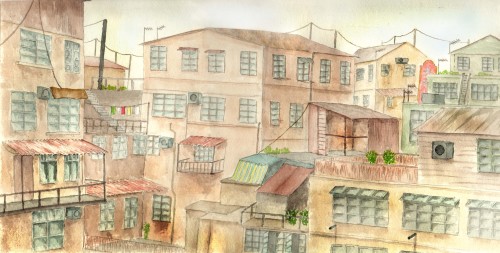
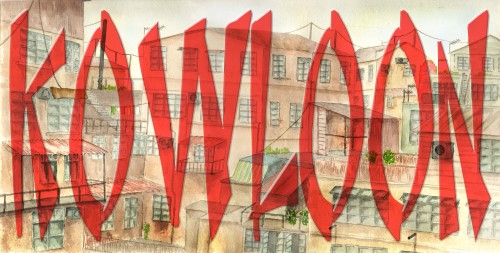
“Kowloon”


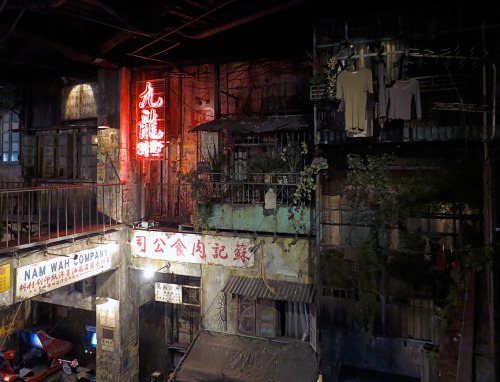
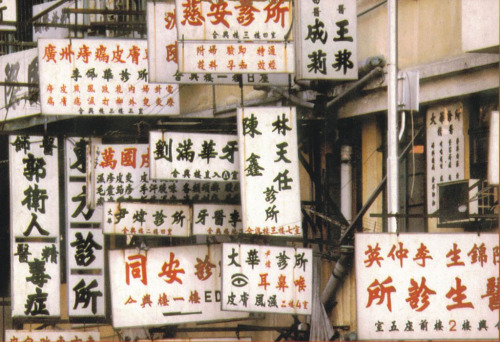
From around 1100 AD, at the time of the Song Dynasty, a fortress had been built on the site in order to secure the trade in salt. When the Japanese were defeated in the Second World War, the Hong Kong Government announced their intention to reclaim jurisdiction over what became known as the ‘Walled City of Kowloon’ and thousands of people flocked there in the hope of gaining the protection of the Chinese. The shanty town grew rapidly during the 1950’s and everything that a city could contain existed there, child welfare clinics by day shared the same space with drinking dens and nightclubs. Across the narrow alleys, ran cables that supplied the city with electricity which had been illegally connected at some place outside of it’s confines. Around the perimeter were the premises of numerous unlicensed doctors and dentists who existed without fear of prosecution.
The Hong Kong Police eventually claimed jurisdiction within Kowloon after a murder trial. Workshops made fake fashion items that closely resembled the high value designer goods that were only available in the department stores of Hong Kong. Smart restaurants bought food items manufactured at a fraction of the normal price and often in less than hygienic circumstances, from tiny workshops that co-existed with rats and open sewers, often with a small number of workers that laboured in dangerous conditions for long hours with small financial reward.
The vast majority of people who lived in the Walled City were honest and law abiding but for some, crime became their only option. The living conditions had become unacceptable to the Hong Kong Government as had the unsavoury reputation that the walled city had gained for itself, and proposals for demolition were announced in the late 1980’s. Generous financial compensation was paid to Kowloon residents although the millions of dollars that had been set aside for this was considered by some to be too little, many stayed on until they were forced to leave.
“Kowloon” by Simon Thompson @tunnelbreeze


Monday, 29 July 2019
Metropolis
“The mediator between the hand and the brain must be the
heart”. This is the epithet to Fritz
Lang's masterpiece silent film “Metropolis".
Released in 1927, this is a story of a distopian city of the future. In Metropolis, the working classes live and work in an underground city whilst the upper classes occupy a futuristic community of skyscrapers and gardens.
The film was noted for its groundbreaking special effects
and its attention to detail. Studio sets were on a grand scale and many scenes
were represented by large models.
Fritz Lang was an exacting director and filming lasted for
17 months from May 1925. Some short scenes took two whole days to
complete. For the sequence where the
worker’s city is flooded, 500 children were brought in from the poorest parts
of Berlin. They were required to work for 14 days standing in a pool of very
cold water while numerous re-takes were ordered. A robot poses as a false
version of the character Maria. When ordered to be burnt at the stake, the
director required this to be carried out with real fire. The dress of the
leading actress Bridgit Helm caught fire in the process.
New special effect processes were invented including a
system of mirrors which gave the impression that the actors were inhabiting the
model city.
After release, the full version of the film, which lasted
for over two hours, was cut considerably by the distributors with further
editing bringing the running time down to 90 minutes. The original film was lost until in 2007, a full length copy was
discovered in Argentina. Although in damaged condition, it has enabled the
restoration of an almost complete version of the film. In the public domain,
this may be viewed on YouTube.
“Metropolis” was much admired by Germany's emerging National
Socialist movement and the Nazi party's propaganda minister hoped that the
director would make films on their behalf.
Fritz Lang, however escaped to Paris shortly afterwards and later to the
United States.
We have colourised a number of stills from the film and these
are presented in chronological order. They do not attempt however, to tell the full story of “Metropolis”
![]() |
| Steam sirens signal a change of shift and the workers descend to tend to the machines that power the city. |
![]() |
| The women of the Eternal Gardens entertain Freder, played by Gustav Fröhlich |
![]() |
| Maria, played by Bridgit Helm, brings the worker's children to see the Eternal Garden. "Look ! These are your brothers" |
![]() |
| Freder walks through the streets of the Upper City. Note the posters in the style of the Bauhaus Movement, popular at that time. |
![]() |
| Regimented groups of workers, uniformly clothed stand in the main square of the Worker's Underground City. |
![]() |
| A lone man walks through the streets of the Upper City. |
![]() |
| Maria addresses the workers at the Catacombs |
![]() | |
| A worker struggles to save the machine from destruction |
![]() |
| In the Cathedral, Freder confronts Death and the Seven Deadly Sins. |
![]() | |
| A robot takes on the embodyment of Maria. |
![]() |
| Freder suffers from hallucinations |
![]() |
| Death descends upon the city |
Tuesday, 16 July 2019
From Tiller Girl to Baroness
Born in Dewsbury, Yorkshire, in 1929, Betty Boothroyd is best known for her term of office as Parliamentary Speaker. A shop girl on leaving school, she soon became a professional dancer joining the famed Tiller Girls dance troop where she stayed from 1946 until 1954. She then entered politics becoming secretary to Barbara Castle followed by a number of other roles. She entered Parliament herself in 1973 winning the by-election at West Bromwich after failing to be elected on a number of previous occasions. Betty Boothroyd was elected Speaker in 1992, the only woman to have held the position. On resigning in 2000, she also left Parliament having taken the Chiltern Hundreds. Awarded a life peerage in 2001 she has continued her career in the House of Lords where she remains a highly respected if a forthright member.
http://www.tunnelbreeze.com/2019/02/ashes.html?spref=tw … #writingcommuntiy #writerslife #amwriting #Freelance
0 replies
0 retweets
0 likes
This blog has been verified by Rise: Ra8c14749497194b75d84a9f6f9f7b49
![]() |
| On the capaign trail in West Bromwich in 1973 |
Subscribe to:
Posts (Atom)